AI Chatbot Safety in Education: 7 Essential Privacy Best Practices Every School Needs
AI chatbot safety in education explained: real privacy risks, FERPA and COPPA basics, and practical steps schools can use today.
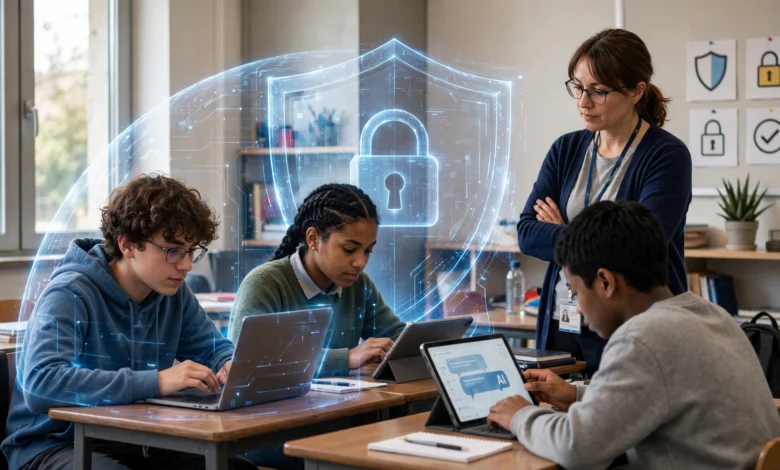
AI chatbot safety in education has moved from a nice-to-have talking point to a real operational concern for schools, districts, and universities. Teachers are using chatbots to draft lesson plans, students are using them to study, and administrators are trying to keep up with tools that changed faster than most policies could be written. The problem is that convenience and privacy don’t always move in the same direction. A chatbot that saves a teacher twenty minutes on grading feedback might also be quietly storing a student’s name, learning struggles, or home situation on a server nobody in the building has ever reviewed.
This article looks at what student data privacy actually means when AI chatbots are involved, why AI chatbot safety in education deserves more attention than it usually gets, and what schools can do about it without banning useful tools outright. We’ll walk through the legal backdrop (FERPA and COPPA, in plain language), the specific risks that show up in classrooms, and seven practices that hold up whether you’re a single teacher piloting a tool or a district rolling one out to thousands of students. The goal isn’t to scare anyone away from AI. It’s to make sure the tools schools adopt actually protect the students using them, instead of quietly working against their interests.
Why AI Chatbot Safety in Education Matters Now
A few years ago, “AI in the classroom” mostly meant adaptive quizzes and spell-check. Now it means students typing full conversations into chat interfaces, uploading essay drafts, and asking questions that reveal a lot more than a multiple-choice answer ever could. That shift changes the stakes.
Here’s the part that often gets missed: most consumer AI chatbots were never built with children or classrooms in mind. They were built for general audiences, with terms of service written for adults who can consent for themselves. When a twelve-year-old logs into a free chatbot account to get help with a math problem, they’re often agreeing (or their teacher is agreeing on their behalf) to terms that were never designed for a K-12 setting. That mismatch is where most of the risk in educational AI safety lives.
A handful of trends are pushing this issue higher on every administrator’s list:
- Free, consumer-grade chatbots are widely accessible and easy for students to use without any school oversight.
- More districts are formally piloting AI tools, which means more student data is flowing to third-party vendors than ever before.
- Regulators have sharpened their expectations. Amended children’s privacy rules that took full effect in 2026 require stricter parental consent and clearer data retention policies from any platform handling data from users under 13.
- Parents and students themselves are asking pointed questions about where their conversations go after they hit send.
None of this means AI chatbots don’t belong in schools. It means AI chatbot safety in education has to be treated as its own category of decision-making, not an afterthought bolted onto a broader technology rollout.
Understanding the Privacy Risks of AI Chatbots in Schools
Before getting into best practices, it helps to be specific about what’s actually at risk. “Privacy” can sound abstract until you break it down into what a chatbot collects, where that information goes, and who can see it later.
What Counts as Student Data
Most people picture obvious identifiers when they hear “student data”: names, birthdates, student ID numbers. Those matter, but student data privacy in an AI context covers far more ground than that.
- Directly identifying information — full name, email, date of birth, home address, photo.
- Indirectly identifying information — a grade tied to an assignment, a discipline note, an IEP detail, a recommendation letter that names a specific student even if the file itself is untitled.
- Behavioral and interaction data — how long a student spends on a task, what kinds of mistakes they make repeatedly, what topics they ask about most.
- Inferred data — patterns a chatbot’s underlying model can pick up on over time, like reading level, emotional tone, or even signs of a learning difficulty, none of which the student ever explicitly stated.
That last category is easy to overlook, but it’s often the most sensitive. A chatbot doesn’t need a student’s name attached to a message to build a profile of that student’s habits, struggles, and interests over a semester.


How Chatbots Collect and Store Information
Every prompt a student types, every file they upload, and every follow-up question they ask becomes a data point somewhere. What happens to that data point depends entirely on the vendor.
- Some platforms retain conversations indefinitely unless a school or district specifically negotiates a shorter retention window.
- Some free-tier tools use conversation data to train or improve their underlying models, meaning a student’s input could theoretically influence how the model responds to other users later.
- Enterprise or education-tier versions of the same tool often behave very differently, with contractual guarantees that student data won’t be used for training and will be deleted on a defined schedule.
This is the detail that trips up a lot of schools: the same chatbot brand can be safe or unsafe depending entirely on which version is deployed. A teacher using a personal, free account is operating under consumer terms. A district using a signed enterprise agreement is operating under very different, usually much stricter, terms. Confusing the two is one of the most common privacy mistakes in schools today.
FERPA, COPPA, and the Legal Landscape
Two federal laws sit at the center of AI chatbot safety in education in the United States, and understanding the difference between them matters.
FERPA (Family Educational Rights and Privacy Act) protects the education records that schools themselves create and maintain. It gives parents and eligible students rights to access and correct those records, and it restricts how schools can share them. FERPA doesn’t regulate AI vendors directly. Instead, schools typically rely on something called the “school official exception,” which lets them share student records with a vendor without separate parental consent, but only if that vendor is bound by a proper agreement limiting how the data can be used. You can read the U.S. Department of Education’s own guidance on this at the Student Privacy Policy Office, which is the most current source for how FERPA applies to modern ed-tech tools.
COPPA (Children’s Online Privacy Protection Act) works differently. It applies to any online service, including a chatbot, that collects personal information directly from children under 13, regardless of whether a school is involved. Amendments that reached full enforcement in 2026 tightened this considerably, requiring separate, verifiable parental consent before a child’s data can be shared with third parties, along with written data retention policies from the vendor. The Federal Trade Commission’s guidance on children’s privacy is the authoritative place to check current requirements, since enforcement details have shifted more than once in recent years.
The practical takeaway for schools: FERPA governs what your institution does with records, and COPPA governs what a vendor’s platform does the moment a young student interacts with it directly. A chatbot can violate one, the other, or both, and a well-intentioned teacher can trigger a violation without ever realizing it happened.
7 Best Practices for Safe AI Chatbot Use in Education
This is where AI chatbot safety in education stops being a legal concept and becomes a set of decisions a school can actually make. None of these require a technical background. They require someone in the building to own the process.
1. Vet Every Vendor Before Adoption
Before any chatbot touches a classroom, someone should be asking the vendor direct questions: Where is data stored? How long is it kept? Is it used to train the model? Can it be deleted on request? A vendor who hesitates to answer these questions in writing is telling you something important on its own. Build a simple tracking sheet listing every AI tool used across your school, what type of data it touches, and where that data lives. It sounds basic, but a surprising number of compliance gaps happen simply because nobody had a single place tracking which tools were even in use.
2. Get a Signed Data Privacy Agreement
A verbal assurance from a sales rep is not a legal protection. A Data Privacy Agreement (DPA) is a contract that specifies exactly how a vendor will handle student data, including retention limits, no-training clauses, and breach notification timelines. Insist on this before any student logs in, not after a pilot has already started. If a vendor can’t produce a DPA, that’s a strong signal to look elsewhere.
3. Limit What Students Can Input
Even with a solid contract in place, the safest input is one that was never entered. Teach students, and remind staff, that a chatbot doesn’t need a full name, a home address, or specific health information to be useful. Encourage generic phrasing over identifying details wherever possible. This single habit reduces exposure more than almost any policy document.
4. Use Age-Appropriate, Education-Tier Tools
Free consumer chatbot accounts and education-specific tiers of the same product are not interchangeable. Education-tier deployments typically come with the contractual protections COPPA and FERPA compliance actually require. Reserve consumer-grade, ungoverned tools for adult staff use only, and never for direct student interaction, no matter how convenient the free version seems in the moment.
5. Train Teachers, Students, and Parents Separately
A single all-staff training session rarely covers what each group actually needs to know. Teachers need to understand what counts as identifiable information in a prompt. Students need age-appropriate guidance on what not to share and why. Parents need a plain-language explanation of what tools are being used and what rights they have to review or object. Treating these as three separate conversations, rather than one generic memo, tends to produce far better understanding.
6. Monitor Chatbot Interactions Responsibly
Oversight isn’t about reading every message a student sends. It’s about having a system in place to flag concerning patterns, whether that’s a student sharing something that suggests they’re in distress or a chatbot giving consistently inaccurate academic guidance. Real-time or periodic review, done with clear boundaries around what staff can and can’t access, keeps a human in the loop without turning monitoring into surveillance.
7. Build a Clear Incident Response Plan
Even with strong safeguards, something will eventually go wrong: a data exposure, a chatbot giving harmful advice, a student sharing information they shouldn’t have. Schools that handle this well have a plan written down before it’s needed. Who gets notified first? What gets communicated to parents, and on what timeline? Who decides whether a tool gets suspended while the issue is investigated? Figuring this out during an actual incident wastes time you don’t have.
Common Mistakes Schools Make with AI Chatbots
A few patterns show up again and again when schools run into trouble with AI chatbot safety in education:
- Assuming a well-known brand name means the tool is automatically safe, without checking which specific tier or account type is actually being used.
- Letting individual teachers choose and deploy tools independently, with no district-level visibility into what’s being used or how.
- Treating a single privacy training session as sufficient, rather than revisiting it as tools and regulations change.
- Focusing only on younger students, when older students often share far more sensitive information in longer, more detailed conversations.
- Waiting for a vendor’s marketing page to answer compliance questions, instead of requesting documentation directly.
Each of these is fixable, and none require major budget increases. Most come down to putting a clear process in place and making sure someone is actually responsible for following it.
Building a Culture of Responsible AI Use
Policies and contracts matter, but they only go so far without a broader mindset shift. The schools that handle this well tend to treat AI chatbot safety in education as an ongoing conversation rather than a one-time checklist. They revisit vendor agreements annually. They ask students directly what tools they’re using outside of school-approved platforms, since that unofficial use often carries the most risk. They make it normal for a teacher to ask “is this tool actually approved?” before assigning it, the same way they’d double-check a field trip permission form.
There’s also an equity dimension worth naming directly. Students who are already discussed in more sensitive detail by staff, those with IEPs, English language learners, or students on behavior plans, are often the same students whose data ends up most exposed in prompts and uploads. Privacy failures don’t land evenly across a student population, which is one more reason this deserves careful, consistent attention rather than a one-and-done policy rollout.
Conclusion
AI chatbot safety in education isn’t about rejecting useful technology out of caution. It’s about making sure the tools schools bring into classrooms actually respect the students using them, from how data is collected to how long it’s kept and who can see it. Understanding the difference between FERPA and COPPA, vetting vendors properly, securing signed data agreements, limiting unnecessary input, choosing education-tier tools, training each stakeholder group separately, monitoring responsibly, and having an incident plan ready are not complicated ideas individually. Together, they form a foundation that lets schools use AI chatbots with confidence instead of guesswork, and that protects the students who have the least ability to protect themselves.