Self-Paced Learning in the K–12 Classroom: A Practical Guide (7 Proven Steps)
Self-paced learning helps K–12 teachers meet every student where they are. Here's a practical, research-backed guide to doing it well.
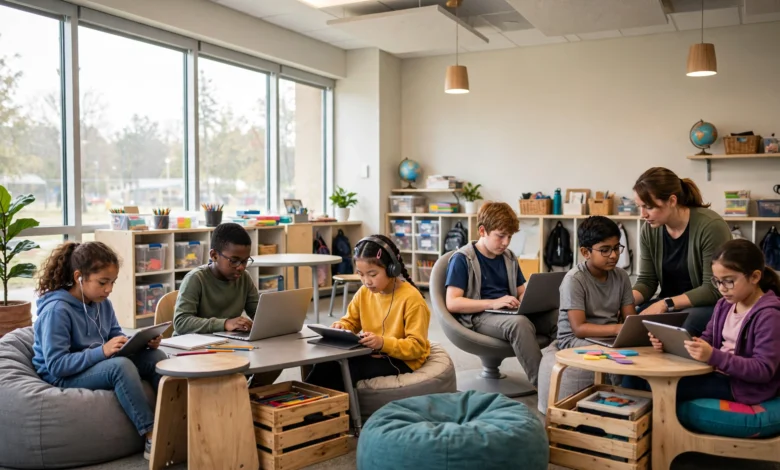
Self-paced learning has moved from a niche experiment to something most K–12 teachers have at least tried, whether through a learning management system, a rotation model, or a simple choice board. And it makes sense why. Anyone who has taught a class of twenty-five or thirty kids knows that “on grade level” is a fiction. Some students finish a worksheet in four minutes and sit there bored. Others need three more days with the same concept before it clicks. A single fixed pace can’t serve both.
Self-paced learning in the K–12 classroom is an instructional approach where students move through content based on their own understanding and readiness, rather than a shared class clock. It doesn’t mean no structure. Good self-paced systems still have deadlines, checkpoints, and clear learning targets. What changes is who controls the day-to-day speed: instead of the teacher deciding “we all move to Lesson 4 on Thursday,” the student decides when they’re ready to move on, based on evidence they’ve mastered Lesson 3.
This guide walks through what self-paced learning actually looks like in practice, the research behind it, how to set it up without losing your mind, common pitfalls, and how to know if it’s working. Whether you’re a classroom teacher testing this in one unit or a curriculum coordinator planning a schoolwide shift, you’ll find a practical starting point here rather than just theory.
What Is Self-Paced Learning?
Self-paced learning is sometimes called mastery-based learning or competency-based learning, though the terms aren’t perfectly interchangeable. At its core, it means students progress through material according to their demonstrated understanding, not a fixed calendar. A student moves to the next lesson when they’ve shown they’ve mastered the current one, not because Tuesday arrived.
This is different from independent study or “do it yourself” learning. In a well-run self-paced classroom, the teacher is still designing the sequence, teaching key concepts, checking for understanding, and intervening when a student is stuck. The pacing is flexible. The instruction and accountability are not.
How It Differs From Traditional Pacing
In a traditional classroom, the calendar drives instruction. Everyone covers Chapter 5 the same week, takes the same quiz on the same day, and moves to Chapter 6 together, regardless of who actually understood Chapter 5. In a self-paced model, mastery drives the calendar. A student who nails a concept quickly can move ahead. A student who needs extra time gets it, without the stigma of “falling behind the class,” because there’s no single class pace to fall behind.
Related Approaches Worth Knowing
- Mastery-based learning: students must demonstrate proficiency (often through a set score on a quiz or task) before advancing.
- Blended learning: combines self-paced digital content with live, teacher-led instruction, often in a rotation model.
- Personalized learning: a broader term that includes self-paced elements but also covers choice in content, product, and learning environment.
- Differentiated instruction: adjusting how content is taught for different learners; self-pacing is one tool within this larger practice.
Why Self-Paced Learning Works: What the Research Says
It’s worth grounding this in evidence rather than just intuition, because “let kids go at their own speed” can sound like a nice idea without much behind it. It isn’t.
- Retention improves when learners control their own study pace. Research by cognitive scientists Nate Kornell and Robert Bjork found that learners who decide when and how to study material retain it better over time compared to those on a fixed schedule.
- Self-regulation skills grow with practice. A study by René Kizilcec and colleagues on self-paced online learners found that students who set goals, plan strategically, and monitor their own progress tend to perform better, which suggests self-pacing can build these habits rather than just require them.
- Mastery-based programs show measurable gains. A meta-analysis of more than 100 mastery learning programs, led by researcher James Kulik, found consistent positive effects on student achievement across K–12 and higher education, with the largest gains among students who typically need more time to learn a concept.
None of this means self-paced learning is automatically better than every other approach. It means that, done well, it has real support behind it, particularly for building independence and helping struggling students catch up without shame.
Key Benefits of Self-Paced Learning in K–12
1. Mastery Over Memorization
When students can’t move forward until they’ve actually demonstrated understanding, you avoid the common trap of a class racing through content that half the room hasn’t truly learned. Self-paced learning forces a shift from “did we cover it” to “did they get it.”


2. Built-In Differentiation
Instead of creating three separate lesson plans for three ability groups, self-paced structures let the differentiation happen naturally. Struggling students spend more time on foundational material. Advanced students move ahead or go deeper, without needing a separate enrichment unit built from scratch.
3. More Time for Small-Group and One-on-One Instruction
When students aren’t all doing the same thing at the same time, the teacher isn’t stuck lecturing to the whole room. That frees up real time to pull a small group who’s stuck on the same misconception, or sit one-on-one with a student who needs it.
4. Reduced Boredom and Reduced Frustration
Fast finishers stop becoming behavior problems because they’re not sitting idle. Students who need more time stop feeling humiliated by being “the one still on page 12” in front of the whole class, because there’s no single shared page anymore.
5. Stronger Ownership and Self-Regulation
Students in self-paced classrooms have to track their own progress, plan their time, and decide when they’re ready for an assessment. Those are executive-function skills that matter well beyond any single subject, and they don’t develop if a teacher makes every pacing decision for a student.
Formats: What Self-Paced Learning Actually Looks Like
There’s no single template. Here are the most common formats used in K–12 classrooms today.
- Unit-based pacing guides: students receive a checklist or tracker for a full unit and move through lessons, videos, and practice at their own speed, hitting checkpoints along the way.
- Playlists: a sequenced list of tasks (readings, videos, practice sets, projects) that students work through in order, sometimes with branching paths based on performance.
- Station rotation with a self-paced station: part of blended learning, where one station is a digital, self-paced task while others are teacher-led or collaborative.
- Choice boards: students pick from several options to demonstrate the same skill, often paired with a suggested pace but flexible deadlines.
- Mastery checkpoints: short quizzes or tasks gate progression; students can’t move to the next lesson until they pass, sometimes with a required minimum score like 80%.
How to Implement Self-Paced Learning: A Step-by-Step Guide
Step 1: Start With One Unit, Not the Whole Year
Trying to convert an entire course to self-paced learning overnight is how most attempts fail. Pick one unit, ideally one with clear, sequential skills (math is often easier to start with than a discussion-heavy humanities unit), and pilot it there.
Step 2: Break Content Into Clear, Sequenced Chunks
Students need to know exactly what “done” looks like for each piece. Break the unit into small lessons or tasks, each with a specific learning target. Vague chunks (“Chapter 5”) don’t work nearly as well as specific ones (“Solve one-step equations with negative numbers”).
Step 3: Build in Checkpoints, Not Just an End Test
Mastery checks along the way, not just one big test at the end, are what actually make self-paced learning work. A short 5-question check after each lesson tells both you and the student whether they’re ready to move on.
Step 4: Create a Pacing Tracker
Give students a visible way to track where they are, whether that’s a paper checklist, a spreadsheet, or a dashboard inside your learning management system. This does double duty: it builds student ownership, and it gives you a fast way to scan the room and see who’s stuck.
Step 5: Set Guardrails, Not Just Freedom
Fully open-ended pacing tends to fall apart, especially with younger students or students still building self-regulation skills. Set a recommended pace (“most students will finish Lesson 3 by Friday”) alongside a hard deadline for the unit, so students have room to move but not room to disappear.
Step 6: Plan for What You’ll Do With Freed-Up Time
Once you’re not lecturing to the whole class every day, decide deliberately how you’ll use that time: pulling small groups, running one-on-one conferences, or providing enrichment for students who move ahead quickly. If you don’t plan this, that time tends to evaporate.
Step 7: Build a System to Catch Students Who Fall Behind
This is the single biggest risk of self-paced learning, and it’s worth its own section below.
Common Challenges (And How to Handle Them)
The “Invisible Struggler” Problem
Self-paced learning fails most often when a struggling student goes unnoticed. In a traditional classroom, a student who’s lost is often visible, since the whole class is on the same page and they’re clearly not following along. In a self-paced classroom, a student who’s stuck can just… stay stuck, quietly, for days, especially if they’re not the type to raise a hand and ask.
The fix is visibility without constant manual check-ins. Use your pacing tracker or LMS dashboard to scan for students who haven’t moved in a day or two, and build a routine (weekly, at minimum) where you specifically check on anyone who looks stalled.
Uneven Motivation
Some students thrive with control over their pace. Others, especially those who’ve spent years in highly structured classrooms, may initially feel adrift without someone telling them exactly what to do next. This is a normal adjustment period, not a sign that self-pacing doesn’t work for that student. Scaffolding self-direction, the same way you’d scaffold any other skill, usually resolves it within a few weeks.
Logistics of Grading and Feedback
If every student is on a different lesson, giving timely feedback gets harder to manage than “grade one stack of identical worksheets.” Auto-graded checkpoints for lower-stakes formative work, reserving your personal feedback time for higher-value tasks, tends to keep this manageable.
Parent and Administrator Skepticism
Some parents worry self-paced means “unstructured” or “unsupervised.” Clear communication up front, showing the pacing guide, the deadlines, and how mastery is checked, usually resolves this quickly. It helps to frame it as flexible structure, not the absence of structure.
Tools That Support Self-Paced Learning
You don’t need expensive technology to run a self-paced classroom; plenty of teachers do it with paper trackers and stations. That said, digital tools can make tracking and differentiation considerably easier:
- Learning management systems (Canvas, Schoology, Google Classroom) for hosting sequenced content and tracking completion.
- Adaptive practice platforms that adjust difficulty based on student performance.
- Shared spreadsheets or trackers for a low-tech way to see who’s where at a glance.
- AI-supported classroom tools, which some teachers now use to answer routine student questions so kids aren’t stuck waiting for help while working independently.
Whatever tool you choose, the goal is the same: give students a clear next step, and give you visibility into who needs help before they fall too far behind.
Measuring Whether It’s Working
Self-paced learning isn’t something you set up once and walk away from. Watch for a few concrete signals:
- Completion rates by checkpoint. Are most students hitting the recommended pace, or is a large group consistently behind?
- Mastery scores on checkpoints, not just the final test. Are students actually demonstrating understanding at each stage, or coasting through?
- Time-on-task data, if your tools track it. Long stalls on a single lesson are an early warning sign.
- Student self-report. A short weekly check-in (“What are you stuck on? What do you need?”) surfaces problems trackers alone can miss.
Adjust the pacing guide, the checkpoints, or your intervention routines based on what you see. Treat the first run of any self-paced unit as a draft, not a finished product.
Is Self-Paced Learning Right for Every Classroom?
Probably not in a pure, unlimited form for every grade and every subject. Younger students (early elementary, especially) generally need more structure and shorter self-paced windows. Highly discussion-based subjects, like a literature seminar built around shared reading and debate, don’t always translate cleanly to fully independent pacing, since the discussion itself depends on everyone having read the same material at the same time.
What tends to work well across most contexts is a hybrid: self-paced skill practice and content delivery, combined with scheduled live instruction, discussion, and collaborative work. This mirrors what researchers at the Modern Classrooms Project have documented across hundreds of classrooms: blended, mastery-based models that pair self-paced work with regular teacher check-ins tend to outperform either fully self-paced or fully teacher-paced extremes on their own. Organizations like Edutopia have also published extensively on differentiated and mastery-based instruction, offering additional classroom-tested strategies worth reviewing before you build your own system.
Conclusion
Self-paced learning in the K–12 classroom gives students room to move at the speed they actually need, whether that means slowing down to truly master a concept or moving ahead once they’ve already got it. The research behind it is solid: better retention, stronger self-regulation, and real gains from mastery-based progression, particularly for students who need more time. But it isn’t a hands-off approach. It works best with clear learning targets, built-in checkpoints, visible pacing trackers, and a deliberate system for catching students before they fall too far behind. Start small, with a single unit, build your tracking habits, and expand from there. Done thoughtfully, self-paced learning doesn’t replace good teaching; it gives good teaching room to reach more students at once.